

Subject: Industrial AI, Autonomous Process Control, Agentic Frameworks, and Inter-Agent Communication Protocols
Accelerating the Transition from Digital to Intelligent Manufacturing
Abstract
Traditional manufacturing paradigms excel at repetitive, high-volume production through prebuilt deterministic flows. However, these systems face significant scaling bottlenecks due to the “Middleware Trap”—the intensive manual effort required for data preparation, protocol standardization, and logic reconfiguration whenever a process variable changes. This paper proposes a transition toward an Industrial AI Agent Core Framework. By deploying a network of specialized, autonomous agents (Monitor, Content, Simulator, and Coordinator) supported by a robust communication backbone (OPC UA and MQTT), manufacturers can shift from static automation to dynamic orchestration. This study demonstrates how agentic AI handles “Order-by-Option” complexity, speeds up deployment through automated testing, and maintains high precision via Human-in-the-Loop (HITL) governance.

1. Introduction: The Rigidity of Legacy Automation
For decades, Industry 3.0 has been defined by the reliability of the “prebuilt process.” Logic controllers (PLCs) and Manufacturing Execution Systems (MES) handle repetitive tasks with surgical precision. However, this efficiency is brittle. The modern market demands “Mass Customization,” where every order may feature different options.
In traditional systems, a new option requires extensive manual intervention:
-
Data Prep & Standardization: Cleaning and mapping new data points.
-
Middleware Proliferation: Building custom bridges to make legacy apps “recognize” new variables.
-
Process Re-engineering: Manually updating flows, which risks downtime and human error.
This “Rigidity Tax” prevents manufacturers from achieving true agility. The Industrial AI Agent Core solves this by replacing hard-coded logic with an intelligent, adaptive ecosystem.
2. The Industrial AI Agent Core Architecture
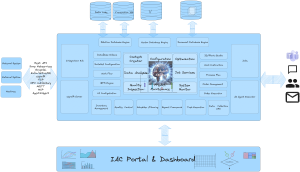
The framework utilizes a Multi-Agent System (MAS) where each agent possesses a specific domain of expertise, working in concert to manage the production lifecycle.
2.1. Functional Agent Taxonomy
| Agent Name | Core Responsibility | Impact on Manufacturing |
| Monitor Agent | Environmental Awareness | Detects anomalies or new options at the data ingress point. |
| Content Agent | Logic Generation | Synthesizes new configurations/parameters for unrecognized options. |
| Simulator Agent | Risk Mitigation | Validates changes in a digital twin before physical execution. |
| Test Agent | Quality Assurance | Automatically runs unit tests on new logic to prevent failures. |
| Coordinator Agent | Governance & HITL | Manages human approvals for anomalous or high-risk flows. |
| Deployment Agent | Execution | Packages and pushes validated changes to the shop floor. |
| Optimization Agent | Continuous Improvement | Tunes parameters in real-time based on running KPIs. |
3. The Communication Nervous System
For agents to act autonomously, they require a standardized method to ingest data from machines and send commands to the edge.
3.1. Semantic Interoperability via OPC UA
The framework utilizes OPC UA (Open Platform Communications Unified Architecture) as the primary source of truth.
-
Contextual Data: Agents leverage the OPC UA Information Model to understand context (e.g., recognizing that “180” is an “Extruder Temperature in 180°C,” not just a raw integer).
-
Security: Using X.509 certificates, agents securely subscribe to specific nodes to monitor machine states.
3.2. Asynchronous Orchestration via MQTT
While OPC UA provides the structure, MQTT (Message Queuing Telemetry Transport) facilitates high-speed communication between agents. This Pub/Sub architecture allows the Monitor Agent to broadcast an “Anomaly Detected” message, which the Simulator and Content Agents receive and act upon simultaneously without being hard-coded to one another.
4. Methodology: The “Anomalous Flow” and HITL Governance
When the system encounters a new production requirement, it initiates an Autonomous Correction Cycle:
-
Detection & Synthesis: The Monitor Agent identifies the gap; the Content Agent generates the logic.
-
Virtual Validation: The Simulator Agent calculates the predicted impact on Overall Equipment Effectiveness (OEE). The agent optimizes for the lowest total cost:
$$C_{total} = \sum_{i=1}^{n} (P_i \times T_i) + M_{cost}$$Where $P$ is the production rate, $T$ is time, and $M$ is the maintenance/changeover cost.
-
Human Governance: The Coordinator Agent manages the approval gate. If the proposed change’s confidence score $C < 0.98$, it triggers a notification to a human operator.
-
Deployment: Once approved, the Deployment Agent pushes the package. The success of the deployment is validated by:
$$P_{success} = \prod_{i=1}^{n} (V_{agent, i})$$Where $V$ represents the validation status of each agent in the chain.
5. Strategic Use Cases
5.1. Agentic Quality Inspection
Traditional vision systems suffer from “False Rejects” due to lighting or minor variations. AI agents cross-reference visual data with environmental sensors via MQTT. If a potential defect is detected, the Monitor Agent queries the Content Agent for historical rework parameters, allowing the Coordinator to ask the human for a “Rework Flow” instead of scrapping the part.
5.2. Predictive Maintenance (PdM) 4.0
Instead of static alerts, the PdM Agent uses OPC UA to monitor vibration. It communicates with the Optimization Agent to calculate a reduced “Safe Mode” speed:
This allows production to continue at 80% capacity rather than suffering a total shutdown while waiting for parts.
6. Conclusion
The transition to an Industrial AI Agent Core Framework is the next evolution of Smart Manufacturing. By automating the “data prep” and “middleware logic” layers, manufacturers can drastically reduce lead times and engineering overhead. This framework doesn’t just “code” or “chat”—it acts as a decentralized brain that ensures every change is simulated, tested, and human-approved before it hits the production line. The result is a factory that is not just automated, but truly autonomous, precise, and resilient.
Leave a Reply