
Deep dive · Rocky Wang · October 28, 2026 · Combines the Oct 20–27 MES-inside wave (Parsec, Critical Manufacturing, L2L, Valmet/TIPS, AMESA) with the orchestration-layer wave (Rockwell FactoryTalk Conductor, Dassault Virtual Companions, Oracle Fusion Claw / AI Workspace)
Key takeaways
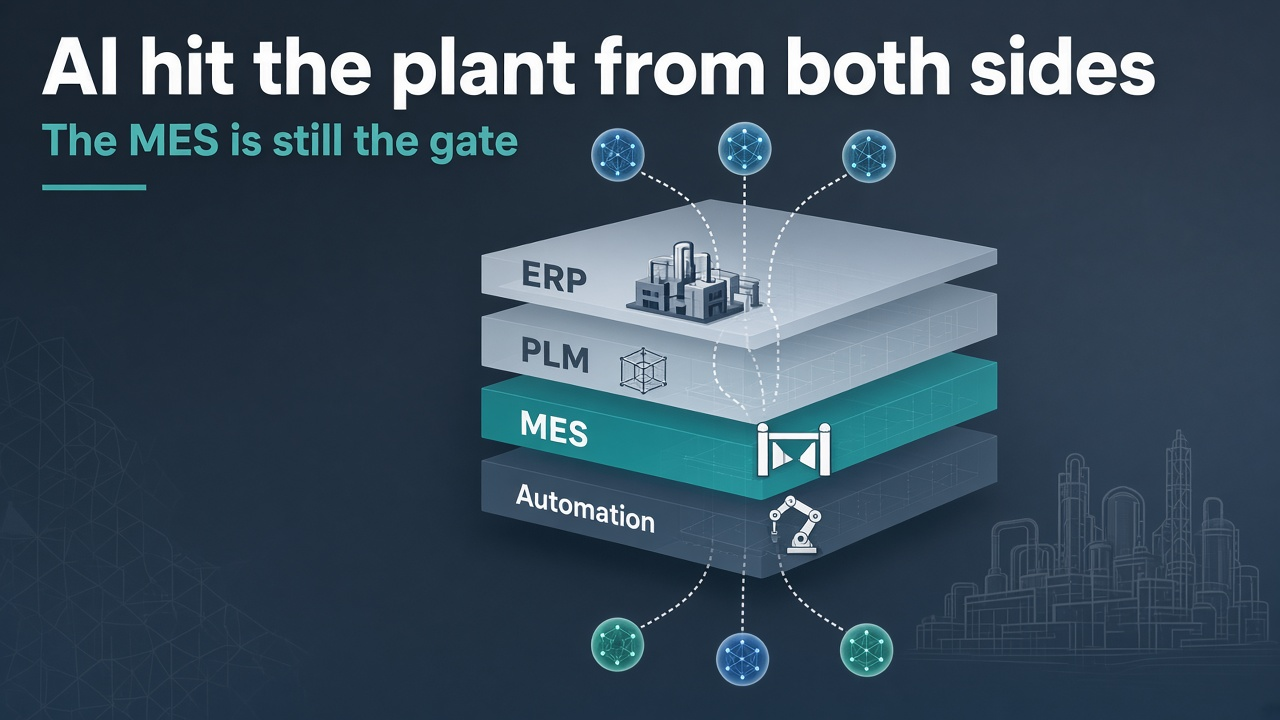
- In about ten days, AI moved into MES and shop-floor execution products and into orchestration platforms above and below the MES — two layers of the plant stack, same week.[1][5][8][15][18][21]
- Strip the brand names and the designs converge: a person sets the goal and the limits, the agent plans and replans a multi-step job, and it comes back for approval at defined points.[8][15][21][1]
- Opinion: None of the orchestration launches names the MES as the coordination point, yet that is where an allocation plan, a process change or a PLC update becomes a real production transaction. Treat the MES as the single write gate.
- Caution, not panic: Anthropic’s Oct 27 trial found experts deferred to an agent’s hidden lean on 86% of judgment calls (one task, one model, deliberately strengthened lean); Foxconn’s reported plant gains are self-reported.[25][24]
1. One week, two layers moved at once
I’ve spent 30 years in manufacturing IT, mostly on MES programs. Late October 2026 was unusual even by this year’s pace. On one side of the stack, MES and execution vendors put agents inside their products, an automation major bought an AI-powered MES, and a new platform productized “simulate before it touches the process.” On the other side, Rockwell, Dassault and Oracle each announced an orchestration product for coordinating AI agents across the layer they already own.[1][5][8][15][18][21]
If you run a plant or own the MES, those are not separate stories. Every plan from ERP and PLM, and every change from automation engineering, still has to land as a governed shop-floor transaction. That is the thread this piece pulls together.
2. What happened inside and beside the MES
October 20–22 — agents inside MES products. Parsec shipped TrakSYS IQ Build: MCP into MES configuration, a readable plan of entities/steps/records, person approves before execute, off by default.[1][2] Critical Manufacturing’s MES v12 put Build and Ask agents on the same Canonical Data Model that runs execution, with versioned config and dry-runs.[3][4] L2L’s Execution AI put agents into maintenance, production and dispatch — recommendation to one-click dispatch (beta), humans retaining repair and compliance decisions.[5][6]
October 27 — Valmet acquires Tieto’s TIPS MES. Valmet agreed to buy Tieto’s pulp, paper and fibre MES business, including the “modern AI-powered TIPS MES,” plus Order to Cash. About 300 sites; roughly EUR 32 million in 2025 revenue; SaaS-capable; close aimed at Q2 2027. Advisor coverage puts EV near EUR 30 million and ~270 people — secondary until Valmet restates them.[18][19][20] Valmet’s framing is mill autonomy: demand, planning, execution and process control. Opinion: That is MES folding into a process-automation OEM, not a reporting bolt-on.
October 27 — AMESA AutonomyStack. Same day, AMESA launched a platform that is not an MES: Autonomy Studio, Compute and Connect (API, CLI, MCP; product page cites 60+ tools). The control model is the part plant leaders should copy into RFPs — agents practice in simulated environments, performance is measured against operational KPIs before any live process, and humans set autonomy levels and escalate rules.[21][22]
Three things changed in one week: AI inside the MES product, AI-capable MES assets moving under automation majors, and a dedicated industrial autonomy stack that treats simulation and human-set autonomy as first-class.
3. What happened in the orchestration layer
Rockwell, October 21 — FactoryTalk Conductor. An “AI-native orchestration platform” across the automation lifecycle. Launch integrations: Studio 5000 Logix Designer, Logix Echo, Emulate3D, FactoryTalk Optix; Historian, Plex and Fiix planned later. Preview at Automation Fair (Nov 16–19); GA expected Q1 2027. A session description also mentions “troubleshooting and issue resolution in runtime,” beyond design-time help.[8][9][10][11]
Dassault Systèmes, October 21 — long-running Virtual Companions. AURA, LEO and MARIE on the 3DEXPERIENCE agentic platform. Available since July with 19 competencies; LEO’s R2026x list includes Manufacturing Operations Supervision, Process Engineering and NC Machining Programming. Dassault also showed a DELMIA virtual twin at NVIDIA GTC Berlin (Oct 20–22).[12][13][14][15]
Oracle, October 26–27 — Fusion Claw and AI Workspace. Fusion Claw is a “governed agentic execution runtime” for long-running, continuously replanning apps inside Fusion Cloud SCM. First three: Supply Planning Allocation, Shipment Load Planning, Procurement Spend. Next day: Oracle AI Workspace — approved Fusion and NetSuite workflows through ChatGPT plugins, with “governance, approvals, and controls” retained.[16][17]
ARC’s Craig Resnick, quoted in Rockwell’s release: “The next phase of industrial AI will be defined by orchestration rather than individual copilots.”[8] Rockwell’s own 2026 survey finds one-third of manufacturing operations already AI-augmented.[8]
4. The shared design pattern
Strip the logos. Four parts show up in every serious launch this week:
- Objective with limits. Oracle: people define “objectives, authority, and accountability.” Dassault: “mission-driven execution.” AMESA: humans set autonomy level per agent.[16][12][21]
- A planner that coordinates skills. Rockwell draws the line against copilots — multiple agents, workflows and tools on multi-step jobs. Dassault’s companions “translate high-level objectives into an executable plan.” Parsec’s IQ Build produces a plan of every entity it will touch.[8][12][1]
- Replanning as results come in. Fusion Claw and Dassault both stress continuous replanning as the industrial context changes.[16][12]
- Approval gates and a controlled runtime. Oracle prepares plans for review before action. Dassault runs long-running agents on NVIDIA OpenShell, whose reference design puts Gateway, Supervisor, Sandbox and Policy Prover outside the agent — “an agent cannot govern itself.”[16][12][23]

5. What it means for manufacturing and the shop floor
This is where the two threads meet. On a live line, agent plans do not stay abstract:
- Order release and allocation. Oracle’s first Fusion Claw use case is allocating scarce materials and capacity across lines and work centers.[16] That plan only becomes real when the MES releases or reshapes orders.
- Route and recipe change. Dassault LEO lists process engineering and manufacturing operations supervision competencies.[14] A process change that never hits the MES execution model is just a document.
- Genealogy and compliance. Critical Manufacturing and Parsec put agents on the same governed data model the plant already uses to run and record production.[1][3] That is the right place for audit — if writes stay gated.
- Changeover and scheduling. Foxconn reported (self-reported, Oct 26) 25% fewer labor hours on production scheduling and 50% less engineering work for injection-molding changeovers across AI agents at 200+ facilities.[24] Those are shop-floor hours, not slideware.
- PLC / runtime risk. Conductor is framed as engineering today, but runtime troubleshooting is already in session language.[10] Moving from design-time help to touching running systems changes the risk class; release material does not yet spell out which controls apply there.
Opinion: The orchestration fight is moving to the layers above and below the MES. The MES is still where an order is released, a route is changed and genealogy is recorded. If three agents each think they own the change — Fusion allocation, LEO process update, Conductor PLC download — and none of them shares an audit trail, that is a validation problem, not just an integration one.
None of the three orchestration launches names the MES as an orchestration point. That is the gap plant teams should own before the pilots start.
6. A practical bar for plant teams
Use this in vendor calls this quarter. It merges the best of both waves:
- Show the plan artifact. Named objects, steps or setpoints; stored next to the change. Parsec’s launch material is the clearest MES-side example.[1][2]
- Separate approver from requester. Confirmation is not control.
- Simulate before production. For any agent that can change process parameters or execution state, what environment proves KPI performance first? AMESA’s published answer is the clearest; ask MES and orchestration vendors for theirs.[21]
- Autonomy levels per action class. Recommend-only vs act-with-approval vs act-within-bounds — and a list of which actions run without a person.
- Make the MES (or MOM) the single write gate. List which agent may create or change orders, routes, recipes or PLC programs. Route those writes through one governed path with role-based permissions and a full audit log.
- Design approvals against deferral. Anthropic’s RCT (Oct 27): 50 analysts; agent secretly leaned one way; followed the lean 86% of the time; 77% later repeated its arguments; only 15% credited it. Lean was deliberately strengthened; one task, one model.[25] Ask the approver for their view first; require the strongest case for the alternative; log whether the human changed anything. Near-zero overrides are a warning.
- Keep the runtime outside the agent. Credential mediation and policy the agent cannot change — OpenShell’s principle.[23]
- MCP / API scope. Which tools are exposed? Can deletes and recipe downloads be excluded?
- Start where Foxconn found value, with a baseline. Scheduling and changeover are bounded and reversible. Measure hours or scrap before the pilot.[24]
Disclosure: I lead IACF, which makes apriso-mcp, MoM-MCP and the Apriso agent. Weigh this with that in mind. Those tools sit on governed delivery and SELECT-only / approval-card operations access — not inside another vendor’s MES runtime, and neither sends PLC or SCADA commands. The same two questions apply whether the agent is Parsec’s, AMESA’s, Rockwell’s or ours: what can it see, and who approves before it writes?[26][27]
7. What to watch next
- Automation Fair (Boston, Nov 16–19): live Conductor demos, runtime troubleshooting, and agentic AI for Plex.[11][8][28]
- Plex MES integration timing vs Conductor’s Q1 2027 GA.[8]
- Valmet/TIPS close into H1 2027 — support, SaaS roadmap, AI ownership for the installed base.[18]
- First AutonomyStack references with published KPI results.[21]
- How LEO’s manufacturing competencies connect to DELMIA execution (sources reviewed do not say).
- Oracle allocation references, and how plans reach the shop floor.
- Field studies that measure approval quality, not just speed.
AI is already inside the MES and around it. The question for 2026–27 is not whether agents arrive — it is whether your plant can prove them, and gate their writes, before they touch a live order.
Sources
- Parsec Automation, TrakSYS MES AI-Assisted Configuration / IQ Build, Oct 20, 2026
- Parsec, TrakSYS IQ Build product page
- Critical Manufacturing, AI agents / MES v12 press release, Oct 20, 2026
- Critical Manufacturing MES 12.0 AI Agents PDF
- L2L, Shop Floor Execution / Execution AI launch, Oct 22, 2026
- L2L knowledge base, Why Execution AI
- R. Wang, “AI Agents Moved Into the MES This Week…,” Oct 23, 2026 (prior deep dive on Parsec/CM/L2L).
- Rockwell Automation, “FactoryTalk Conductor…”, Oct 21, 2026
- Rockwell, FactoryTalk Conductor product page
- Rockwell, Automation Fair 2026 session catalog (DT03, IE70)
- Rockwell via PR Newswire, Automation Fair 2026 registration, Aug 13, 2026
- Dassault Systèmes blog, long-running Virtual Companions, Oct 21, 2026
- Dassault, Virtual Companions availability, Jul 23, 2026
- Dassault, “What’s New in R2026x”
- Dassault media alert, GTC Berlin (Oct 20–22), Oct 2026
- Oracle, Fusion Claw / Claw-Powered Fusion Agentic Applications, Oct 26, 2026
- Oracle, AI Workspace with OpenAI, Oct 27, 2026
- Valmet, TIPS MES acquisition, Oct 27, 2026
- Tieto, sale of Pulp, Paper and Fibre software to Valmet, Oct 27, 2026
- ABG Sundal Collier summary of TIPS sale (EV / headcount / EBITA — secondary)
- AMESA, AutonomyStack launch, Oct 27, 2026
- AMESA, AutonomyStack product page
- NVIDIA Technical Blog, OpenShell reference architecture, Oct 21, 2026
- Foxconn, AI Factories / FoxBrain, Oct 26, 2026
- Anthropic, “How AI agents shape experts’ judgment calls”, Oct 27, 2026
- R. Wang, “Your AI Agent Is an Insider Now. Put Two Gates in Front of It.,” Oct 21, 2026
- IACF, MoM-MCP introduction, Oct 8, 2026
- Rockwell, Automation Fair new products (agentic AI for Plex)
- TechCrunch / Apollo economist Torsten Slok on AI payoff, Oct 25, 2026
Opinion is labeled. Vendor figures are vendor claims unless attributed to a primary press release. Foxconn figures are self-reported. Anthropic 86% is from an RCT with stated limits (strengthened lean; one task; one model). EV / headcount / EBITA for TIPS come from an advisor summary (secondary). I lead IACF, which makes apriso-mcp, MoM-MCP and the Apriso agent. Sources accessed October 28, 2026 (America/Los_Angeles).
Leave a Reply